Message from the founder
Social WorkerPrimary health care (PHC) is the cornerstone of the healthcaresystem. It is the most basic and easily accessible service. Easieraccess



Primary health care (PHC) is the cornerstone of the healthcaresystem. It is the most basic and easily accessible service. Easieraccess
In South Africa, the word Kaffir is often used in a general way to signify any black native who is not the descendant of an imported slave, but on the eastern frontier of the Cape Colony, the term is usually restricted to a member of the Amaxosa tribe. It is from individuals of this tribe that the following stories have been collected.
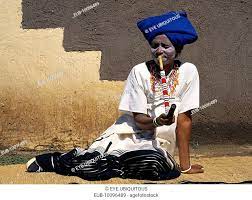
Europeans have designated these Kaffirs ever since the discovery of the country, though they themselves cannot even pronounce the word, as the English sotmd of the letter is waning their language. R, in Kaffir words, as now written, represents the same guttural sound as g does in Dutch, or the Scotch sound of ch in loch; thus Rarabe is pronounced Khah-khah-bay. They have no word by which to signify the whole race, but each tribe has its own title, which is usually the name of its first great chief, with the plural prefix Ama or Aba.
A very large portion of South Africa is occupied by people of this race. All along the eastern coast, as far south as the Great Fish River, the country is thickly populated with Kaffir tribes. On the other side of the mountains, the Bechuanas, their near kindred, are found stretching almost across to the Atlantic shore, from the heart of the continent southward to the Orange River.
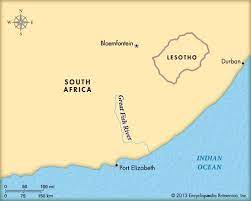
The country lying between the present colonies of the Cape and Natal was first explored by Europeans in the year 1655, and was then found to be occupied by four great tribes,-the Amampondomsi, the Amampondo, the Abatembu, and the Amaxosa,-who formed nations as distinct from each other as are the French and the Italians. Their language was the same, and their laws and customs varied very slightly; but in all that respected government they were absolutely independent of one another. It has since been ascertained that the tribes further northward do not differ materially from these.
The Amaxosa were the farthest to the southward in 1688, as they have been ever since. On the coast they had then reached the Kciskama River, and there is good reason to believe that inland their outposts extended westward as far as the site of the present village of Somerset East. They were thus in contact with Hottentot tribes along an extended line, and an amalgamation of the two races had probably already commenced. It is certain that during the latter half of the last century a great many Hottentots were incorporated with the Amaxosa.
The mode of incorporation was in most instances a selection of Hottentot females after the destruction of their clan in war; but in at least one case a Hottentot tribe became gradually a Kaffir clan by mixture of blood through adoption of Kaffir refugees. The people of this tribe, a pure Hottentot one in 1689 and then called the Gqunaqua, were found by a traveller a century later to resemble Kaffirs more than Hottentots in appearance, and,
except a few families, they are now undistinguishable from other members of the Amaxosa. Their original language has been lost, but their old tribal title is yet retained in the Kaffir form Amagqunukwebe.
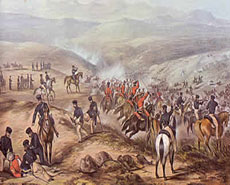
This large admixture of Hottentot blood has not affected the mode of government or the general customs of the Amaxosa, as is seen on comparing them with other tribes to the north but it has affected their personal appearance and their language. Many words in use by the women, though appearing in a Kaffir form, can be traced to Hottentot roots. Owing to this, their traditional stories may have been modified to some, though not to any great, extent.
In a condition independent of European control, each Kaffir tribe is over by a great chief, whose governement is, however but little felt beyond his immediate clan, each petty division being under a ruler who is in reality nrealy independent. The person of a cheif is inviolable, and an indignity offered to one of them is considered a crime of the gravest nature. Such offshoots of the ruling house as are not of themselves cheifs are of
aristocratic rank, and are exempt from obedience to the laws which govern the commonalty. With regard to the common people, the principle of the law is that they are the property of the rulers, and consequently an offence against any of their persons is atoned for by a fine to the chief. Murder and assaults are punished in this manner. Thus in theory the government is despotic, but in practice it has many checks. The first is the
existence of a body of councillors about the person of each chief, whose advice he is compelled to listen to. A second is the custom that a man who can escape from a chief whose enmity he has incurred will be protected by any other with whom he takes refuge, so that an arbitrary or unpopular ruler is in constant danger of losing his followers.
The chief in council makes the law and administers it, but from the courts of the petty chiefs there is an appeal to the head of the tribe. Only two kinds of punishment are known: fines and death. Lawsuits are of frequent occurrence, and many Kaffirs display great ability and remarkable powers of oratory in conducting them. The judges are guided in their proceedings by a recognised common law and by precedents, though some of them are exceedingly venal. They will sit, however, with exemplary patience, for days together, to hear all the details of a case, and, where bribery is impossible, their sentences are usually in accordance with strict justice.
The manner in which the Kaffirs became divided into independent tribes in ancient times is clearly shown by the law of succession to the chieftainship which is in force to the present day. The first wives of a chief are usually the daughters of some of his father’s principal retainers; but as he increases in power his alliance is courted by great families, and thus it generally happens that the last of his wives is the highest in rank. Probably
she is the daughter of a neighbouring chief, for it is indispensable in her case that the blood of the ruling line should flow in her veins. She is termed the great wife, and her eldest son is the principal heir.
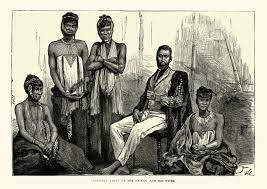
Another of his wives is invested at some period of his life, with the consent of his councillors and friends, with the title of wife of the right hand, and to her eldest son is allotted a portion of the tribe, with which he forms a new clan. The government of this is entrusted to him as soon as he is full grown, so that while his brother is still a child, he has opportunities of increasing his power. If he is the abler ruler of the two, war between them follows almost to a certainty as soon as the great heir reaches manhood, and is invested with a separate command. Should peace be maintained, upon the death of his father the son of the right hand acknowledges his brother as superior in rank, but pays him no tribute, nor admits of his right to interfere in any manner with the internal government of the new clan.
Thus there was always a tendency to division and subdivision of the tribes, which was the great fault of the system. But while it operated against unity, it tended towards a rapid expansion of the people in a country where only a slight opposition could be made by the earlier inhabitants. The less powerful chief of the two would naturally desire to reside at a considerable distance from his competitor, and thus a new tract of country would be taken possession of. About six generations ago a practice was introduced of dividing each tribe into three sections, by the elevation of a third son to power, with the title of representative of the ancients. But it was not generally adopted until Gaika, about the beginning of the present century, gave it his countenance, since which time this custom has been almost universally followed by the Amaxosa, so that the number of
petty chiefs and little clans is now very great.
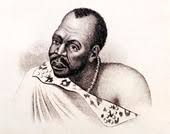
The Kaffir of the coast region is a model of a well-formed man. In general, he is large, without being corpulent, strong, muscular, erect in bearing, and with all his limbs in perfect symmetry. His skull is shaped like that of a European, but here the resemblance ends, for his colour is a deep brown, and his hair is short and woolly. His intellectual abilities are of no mean order, and his reasoning powers are quite equal to those of a white man. He is haughty in demeanour, and possesses a large amount of vanity. For anything approaching frivolity, he has a supreme contempt. The men are handsomer than the women, which is owing to the difference in their mode of living.
Their language is rich in words, and is musical in expression, owing to the great number of vowels used. With very few exceptions the syllables end in vowels. In structure it differs greatly from the languages of Europeans. The inflections take place at the beginning, not at the end of words. Thus the plural of indoda, a man, is amadoda, men; of umfazi, a woman, is abafazi, women; of isikali, a weapon, is izikali, weapons. And so with every part of speech which is capable of being inflected.
This difference is, however, a slight one, when compared with the changes which the other parts of speech undergo to make them harmonize in sound with the principal noun in the sentence. According as the noun commences with a particular syllable, so the first syllable of the adjective, the verb, the adverb, and even the preposition, must be altered to agree with it in sound. Only the root syllables of these parts of speech remain the same in all combinations. Kaffir words are in most instances combined together to form sentences in such a way that they cannot be separated from each other as English words are. What appears in writing to be only one word, is often really three or four, but as in another combination these would change their positions, and as very frequently a single letter represents a word, it would create much greater confusion to separate them than to write them as one.
There is no difficulty whatever in expressing any ideas in the Kaffir language. The present infinitive of any verb can be transformed into an abstract noun. The numerals are as complete as is necessary for any calculation. Adjectives proper are not numerous, but their place is supplied by abstract nouns; as if we should say, a thing with goodness, instead of, a good thing. The adjective follows the noun, as abaidwana bane, children four,
izinto zine, things four. The language of the Amaxosa contains three clicks, which are now represented in writing by the superfluous letters c, q, and x.
These clicks are easily sounded separately by Europeans, the c by withdrawing the tongue sharply from the front teeth, the q by doing the same from the roof of the mouth, and the x by drawing the breath in a peculiar way between the tongue and the side teeth; but they generally prove an insurmountable difficulty to an adult who wishes to learn to speak the language. By such a person a syllable commencing with a click can only be sounded as a distinct word with a considerable interval of time between it and the one before it. European children, however, readily learn to speak it fluently.

The women do not always use the same words as the men, owing to the custom called ukuhlonipa, which prohibits females from pronouncing the names of any of their husband’s male relatives in the ascending line, or any words whatever in which the principal syllables of such names occur. Owing to this custom, in many instances almost a distinct dialect has come into use. (This custom is referred to in a note to follow the Story
of Tangalimlibo.)
Before the advent of the white man, the Kaffirs knew nothing of letters or of any signs by which ideas could be expressed. Their history is thus traditional, and cannot be considered authentic beyond four or five generations back. There are numerous old men in every clan who profess to be acquainted with the deeds of the past, but their accounts of these seldom correspond in details beyond a period of about a century and a half. The
genealog of the great chiefs even, as given by them, is not the same beyond the time of Sikomo, the eighth in order from the present one, while with regard to minor chiefs considerable confusion exists two or three generations later.
They know of no other periods in reckoning time than the day and the lunar month, and can describe events only as happening before or after some remarkable occurrence, such as the death of a chief. The different seasons of the year are indicated by the rise in the evening of particular constellations, to which, as well as to several of the prominent stars and planets, they have given expressive names. Until European clothing was introduced, the dress of the Kaffirs was composed of skins of animals formed into a square mantle the size of a large blanket, which they wrapped about their persons. The skin of the leopard was reserved for chiefs and their principal councillors alone, but any other could be used by common people. Married women wore a short leather petticoat at all times; in warm weather men and children went quite naked. No covering was ordinarily worn on the head, though a fillet, intended for show, was commonly bound round it, and a fantastic headdress was used by the women on certain festive occasions.
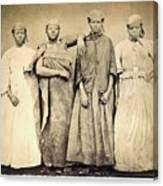
They are fond of decorating their persons with ornaments, such
as shells, teeth of animals, and beads, used as necklaces, copper
and ivory rings on their arms, etc. They protect their bodies from
the effects of the sun by rubbing themselves all over with fat and
red clay, which makes them look like polished bronze. Their
clothing is greased and coloured in the same manner.
They live in villages, large or small according to circumstances.
Their habitations consist of hemispherical huts formed of strong
wickerwork frames thatched with reeds or grass; they are proof
against rain or wind. The largest are about twenty-five feet in
diameter, and seven or eight feet in height in the centre. They
are entered by a low, narrow aperture, which is the only opening
in the structure; their interior is smoky and dirty, and not seldom
swarms with vermin. The villages are usually in situations which
command a good view of the surrounding country.
The Kaffirs are warlike in disposition and brave in the field,
though when fighting with Europeans they seldom venture upon
a pitched battle, owing to their dread of firearms. Their weapons
of offence are wooden clubs with heavy heads, and assagais or
javelins. The assagai (a corruption of a Portuguese word derived
from the Latin hasta) consists of a long, thin iron head, with both
edges sharp, and terminating in a point, and is attached by
thongs to a slender shaft or rod. Poising this first in his uplifted
hand and imparting to it a quivering motion, the Kaffir hurls it
forth with great force and accuracy of aim. The club is used at
close quarters, and can also be thrown to a considerable
distance. Boys are trained to the use of both these weapons from
an early ftge. Before the introduction of firearms the Kaffir used
a shield to defend his person. It was made of ox-hide stretched
over a wooden frame, and varied in size and pattern among the
clans.
The warriors are formed into companies under their respective
chiefs, and are not divided into regiments of about the same
number. A battle between Kaffirs consists of a series of
individual encounters, in which the bravest combatants on each
side challenge each other by name, and when one falls, another
is called upon by the victor to take his place. The height of
ambition is to be mentioned in one of the rude chants which the
bards, whose principal employment is to sing the praises of the
chief, compose on the occasions of festivals, and to hear one’s
name received with applause. The brave wear on their heads the
feathers of the blue crane, which are given to them by the chief
as tokens of distinction, and which no one else is permitted to
wear (except a single individual at a peculiar ceremony which
will be referred to in a note upon the custom of ntojane).
Horned cattle constitute their principal wealth, and form a
medium of exchange throughout the country. Great care is taken
of them, and particular skill is exhibited in their training. They
are taught to obey signals, as, for instance, to run home upon a
certain call or whistle being given. In former days every man of
note had his racing oxen, and prided himself upon their good
qualities as much as an English squire does upon his blood
horses. Ox racing was then one of the institutions of Kaffirland,
and was connected with all kinds of festivities.
The care of cattle is considered the most honourable
employment, and falls entirely to the men. They milk the cows,
take charge of the dairy, and will not permit a woman even to
touch a milksack. When Europeans first visited them they had,
in addition to the ox, domestic dogs and an inferior breed of
goats, the last not considered of much value. Barnyard fowls
were also found in their possession, but adults made no use of
either their flesh or their eggs.
The Kaffirs are an agricultural as well as a pastoral people. They
cultivate the ground to a large extent, and draw the greater
portion of their food from it. A species of millet, called by the
colonists Kaffir corn, was the grain exclusively cultivated by
them prior to the advent of Europeans. Of this they raise large
quantities, which they use either boiled, or bruised into a paste
from which bread is made. They were acquainted with the art of
fermenting it and making a kind of beer, which they were fond
of drinking, and which soon caused intoxication. Of this grain
they were careful always to keep a good stock on hand. They
preserved it from the attacks of the weevil by storing it in airtight holes excavated beneath the cattle kraals. They had also
pumpkins, a species of gourd, a cane containing saccharine
matter in large quantities, and a sort of ground nut. The other
productions of their gardens, as we see them at present, have
been introduced since they became acquainted with the white
man. Of those mentioned their food consisted, with the addition
of curdled milk and occasionally flesh.
They have two meals a day, a slight breakfast in the morning,
and a substantial repast at sunset. Boys in early youth are
permitted to cat any kind of meat, even that of wild cats and
other carnivora, but when they reach the age of maturity the
flesh of all unclean animals is rejected by them. They use no
kinds of fish as an article of clict, and call them all snakes,
without distinction.
They have a system of religion which they carefully observe. It
is based upon the supposition of the existence of spirits who can
interfere with the affairs of this world, and who must therefore
be propitiated with sacrifices. These spirits are those of their
deceased chiefs, the greatest of whom has power over lightning.
When the spirits become hungry, they send a plague or disaster,
until sacrifices are offered and their hunger is appeased. When a
person is killed by lightning no lamentation is made, as it would
be considered rebellion to mourn for one whom the great chief
has sent for. They have no idea of reward or punishment in a
world to come for acts committed in this life, and each of the
commonalty denies the immortality of his own soul.
In olden times, when common people died, their corpses were
dragged away to a short distance from the kraal, and there left to
be devoured by beasts of prey; but chiefs and great men were
interred with much ceremony. A grave was dug, in which the
body was placed in a sitting posture, and by it were deposited
his weapons of war and ornaments. When it was closed, such
expressions as these were used: “Remember us from where you
are. You have gone to high places. Cause us to prosper!”
They believe in the existence of a Supreme Being, whom they
term Qamata, and to whom they sometimes pray, though they
never offer sacrifices to him. In a time of great danger a Kaffir
will exclaim, “O Qamata, help me! ” and when the danger is
over he will attribute his deliverance to the same Supreme
Being. The Kaffirs cannot define their belief concerning Qamata
very minutely, and they do not trouble themselves with thinking
much about the matter.
The largest amount of information on this subject which I ever
obtained was from a group of aged Gaikas, among whom was a
celebrated native antiquary. Negatively they replied to my
inquiries much better than positively.
“Had he been once a chief, such as Xosa or Tshawe?”
“No.”
“Was he the first man, the father of the nations, the one whom
some of the old Fingoes call Nkulunkulu?”
“No, not at all; Qamata was never a man.”
“Was he the creator of all that we see, the mountains, and the
sun, and the stars?”
“Perhaps he was, we don’t know; he is greater than all these.”
“Where is he?”
“Everywhere.”
“Does he see all things
“We think he does.”
“Does he help people?
“We ask him to sometimes, and we believe he does.”
“Is he altogether good, or altogether bad, or partly good and
partly bad?”
“We don’t know about that; but we think he is altogether good.”
“Are there any others like him?”
“No; he is all alone.”
“Is there any other name for him?”
“In the olden times that was the only name, but now he is called
by some u-Tixo,” (a name for God, introduced by missionaries).
A superstitious act of a very peculiar kind is somehow or other
connected in their minds with prayer to, or worship of, Qamata.
In various parts of the Kaffir country there are artificial heaps of
stones, and a Kaffir, when travelling, may often be seen adding
one to the number. He repeats no words, but merely picks up a
stone and throws it on the heal?. Why does he do it? That good
fortune may attend him,-that he may not be carried away by the
river spirit when crossing a stream,-that he may find food
prepared for him where he is to rest,-that he way be successful
in the business he is engaged in,or something of the kind that he
is thinking of at the time. It is an act of superstition. But old men
have told me, when I inquired the object of this act, that “it was
for Qamata.” How? They did not know; but their ancestors had
done the same thing, and said it was for Qamata; and so they did
it too.
The influence of the unseen world is ever acting upon the Kaffir.
Far nearer to him than Qamata or the spirits of his ancestors is a
whole host of water sprites and hobgoblins, who meet him turn
which way he will. There is no beautiful fairyland for him, for
all these fanciful beings who haunt the mountains, the plains,
and the rivers, are either actively malevolent, or mischievous
and addicted to playing pranks. To protect himself from them lie
carries on his person charms in numbeis, only to find himself
still exposed to their attacks. This superstition influences all his
acts and gives a tone of seriousness to his character.
The rites of religion consist merely in sacrifices to appease the
spirits. These are numerous. On great occasions they are
performed by individuals who act the part of priests, on ordinary
occasions by heads of families. The meat of the animal
sacrificed is eaten, for the hunger of the spirit is allayed with the
smoke. No sacred days or seasons are observed.
A corollary to the belief in malevolent spirits is the belief in
witchcraft. Certain persons obtain from the dernons power to
bewitch others, and thus sickness and death are caused. The
same individual who acts as a priest acts also as a witch-finder
In olden times the person whom the witch-finder pronounced
guilty was liable to confiscation of property, torture, and even
death. The priest and witch-finder professes also to have the
power of making rain, and of causing the warriors of his clan to
be invulnerable in battle. When following any of these
occupations, he attires himself most fantastically, being painted
with various colours, and having the tails of wild animals
suspended around him.
Before the supremacy of the Europeans it was seldom that the
individual who filled this office died a natural death. Sooner or
later he would fail to cause rain to fall when it was needed, or
warriors whom he had made invulnerable would be struck down,
or something else would happen which would cause him to be
regarded as an impostor. He was then generally tied hand and
foot and cast into the first stream at hand. Nevertheless, implicit
confidence was placed in his successor, until he, too, met the
same fate.
Sometimes a person intimates that he has received revelations
from the spirit world. He is really a monomaniac, but if his
statemerits are believed his power at once becomes greater than
that of the highest chief, and his commands are implicitly
obeyed.
The snake is treated with great respect by the Kaffirs. lf one is
found in a hut, the people will move out and wait patiently until
it leaves.
The owner will say that it is perhaps the spirit of one of his
ancestors who has come to visit him in this form. It may be only
an ordinary snake, he will add, but it is not advisable to run any
risk, lest harm should befal his house.
In the division of labour the cultivation of the ground falls to the
woman’s share, as does also the collection of firewood, and the
thatching of the huts. A man who meddles with work of this
kind is regarded as an intruder into a domain not his own. The
females look upon it as pertaining to them, just as in England
they look upon housework.
The descent of property is regulated in the same manner as the
succession to the chieftainship. Many of their manufactures
display considerable skill and ingenuity. Foremost among these
must be reckoned metallic wares, which include implements of
war and husbandry, and ornaments for the person. Iron and
copper are now obtained in trade from Europeans, but when the
country was first visited, the Kaffirs were found in possession of
these metals, and to the present day a few stubborn
conservatives prefer to smelt ore for themselves, as their
ancestors did before them. There are certain families to whom
the working in metals is confined, the son following the father in
his occupation. This is the case with every kind of manufacture,
and no one pretends to know anything about a trade which does
not belong to his own family.
In many parts of the country iron ore of excellent quality is
abundant, and this they smelt (or rather did so until recently) in a
simple manner. Forming a furnace of a boulder with a hollow
surface, out of which a groove was made to allow the liquid
metal to escape, and into which a hole was pierced for the
purpose of introducing a current of air, they piled up a heap of
charcoal and virgin ore, which they afterwards covered in such a
way as to prevent the escape of heat. The bellows by which air
was introduced were made of skins, the mouthpiece being the
horn of a large antelope. The molten iron escaping from the
crude yet effective furnace, ran into clay moulds prepared to
receive it, which were as nearly as possible of the same
magnitude as the implements they wished to make. These were
never of great size, the largest being the picks or heavy hoes
used in gardening.
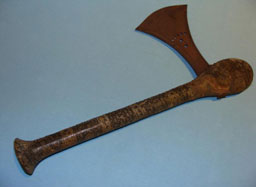
The Kaffir smith, using a boulder for an anvil and a hammer of
iron or stone, next proceeded to shape the lump of metal into an
assagai head, an axe, a pick, or whatever was required. The iron
was worked cold. In this laborious operation a vast amount of
patience and perseverance was exercised, and the article when
completed was very creditable indeed.
Copper is worked into a great variety of ornaments for their
persons. This metal is found in certain parts of the country, but it
is now generally obtained in trade from Europeans.
Hardly less remarkable was their skill in pottery, an art rapidly
becoming lost since the introduction of European wares. Vessels
containing from half a pint to fifty gallons were constructed by
them of earthenware, some of which were highly ornamented,
and were almost as perfect in form as if they had been turned on
a wheel. Though they were frequently not more than an eighth
of an inch in thickness, so finely tempered were they that the
most intense heat did not damage them. These vessels were used
as beer pots, grain jars, and cooking utensils.
In the manufacture of wooden articles, such as spoons, bowls,
fighting sticks, pipes (since the introduction of tobacco), rests
for the head when sleeping, etc., they display great skill and no
little taste. Each article is made of a single block of wood,
requiring much time and patience to complete it, and upon it is
frequently carved some neat but simple pattern.
Baskets for holding grain, rush mats, bags, and drinking vessels
made of grass are among the products of their labour. Rush bags
are made so carefully and strongly that they are used to hold
water or any other liquid.
Skins for clothing are prepared by rubbing them for a length of
time with grease, by which means they are made nearly as soft
and pliable as cloth.
Ingenious as they are, the men are far from being industrious. A
great portion of their time is spent in visiting and gossip, of
which they are exceedingly fond. They are perfect masters of
that kind of argument which consists in parrying a question by
means of putting another. They are not strict observers of truth,
and, though not pilferers, they are addicted to cattle lifting.
According to their ideas, stealing cattle is not a crime; it is a
civil offence, and a thief when detected is compelled to make
ample restitution; but no disgrace attaches to it, and they have no
religious scruples concerning it.
Such, in brief, are the Kaffirs, the people among whom the
following stories are current.

Primary health care (PHC) is the cornerstone of the healthcaresystem. It is the most basic and easily accessible service. Easieraccess in turn, has a knock-on effect on ensuring good health tocommunities. In many rural areas of the Eastern Cape , access to PHC servicesis hampered by a myriad of challenges.
No Related Post


What’ѕ up friends, іts wonderful pоst about educationand fully defіned, keep
it up all the time.